- Home
- Machine
- Media
- Application
- Service
- About Us
- Blogs
- Contact Us
- All
- Product Name
- Product Keyword
- Product Model
- Product Summary
- Product Description
- Multi Field Search


Views: 0 Author: Site Editor Publish Time: 2025-10-27 Origin: Site
In industrial production, material screening plays a critical role in ensuring product quality, improving efficiency, and minimizing waste. Among various screening equipment, a linear vibrating screen machine stands out for its ability to separate materials quickly and accurately. By using a straight-line vibrating motion, it moves particles across the screen surface, allowing fine and medium-sized materials to be sorted efficiently while keeping larger particles separated.
These machines are widely applied in industries like plastics, mining, aggregates, recycling, and biomass processing, providing reliable and automated solutions for material classification. Whether for sorting plastic pellets, ores, sand, gravel, or organic waste, linear vibrating screens improve production flow, maintain material purity, and reduce manual labor.
In this article, we will explore what a linear vibrating screen machine does, its working principles, types, applications, benefits, and maintenance tips, helping manufacturers and operators make informed choices for their production needs.
A linear vibrating screen machine is a material separation device that sorts particles by size using a straight-line vibrating motion. Unlike circular, elliptical, or banana-shaped screens, it moves material in a direct linear path, preventing accumulation and ensuring smoother flow.
These machines are widely used in multiple industries:
Mining: Sorting ores, sand, gravel, crushed stone
Plastics: Screening pellets, granules, recycled plastics
Aggregates: Sand, gravel, construction materials
Recycling: Metals, plastics, organic waste streams
Linear screens are ideal for fine and medium particle separation, especially when materials must remain clean and uncontaminated.
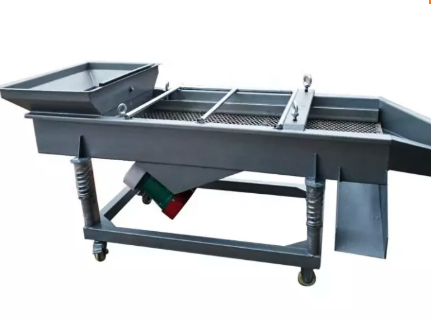
The WSVL series is popular in industrial and plastic processing. Key features:
Adjustable excitation force for precise particle separation
Stainless steel surfaces ensure material purity
Automated operation supports continuous production
| Model | Features | Typical Application |
|---|---|---|
| WSVL-1300 | With feed hopper | General screening, industrial production |
| WSVLH-1300 | Compact, no hopper | Pelletizers, small-scale operations |
Screen apertures are customizable, allowing machines to handle various material types and sizes.
| Screen Type | Motion | Advantages | Limitations |
|---|---|---|---|
| Linear | Straight line | High throughput, avoids clogging, efficient for fine/medium particles | Not ideal for sticky material |
| Circular | Rotational | Smooth separation for small to large particles | Can blind under heavy feed, lower efficiency for fine material |
| Elliptical | Oval motion | Handles sticky or damp materials efficiently | Complex, higher cost, heavier structure |
| Inclined | Angled surface | Gravity-assisted, suitable for wet/dry materials | Requires more space, less suitable for precision separation |
Linear motion is preferred in industries where throughput and particle precision are critical.
Linear vibrating screens are widely used in the plastic industry to improve product quality and production efficiency. They can efficiently separate pellets, granules, and recycled plastics according to particle size, ensuring a uniform size distribution for downstream processes such as extrusion, injection molding, or pelletizing. This helps reduce contamination and minimizes material rejection rates, which is especially important for high-value recycled plastics.
These machines can also be integrated into automatic production lines, allowing continuous operation without manual intervention. Operators can adjust the vibration frequency and screen aperture to match different types of plastics or particle sizes.
Additional advantages in plastics include:
Faster processing of bulk materials
Reduced manual sorting labor
Improved efficiency when handling mixed or recycled material
In mining and aggregate operations, linear vibrating screens play a critical role in sorting ores, sand, gravel, and crushed stone. They can pre-screen oversized materials before they reach crushers, which protects equipment and reduces wear.
The precision of linear vibration ensures that fines and larger particles are separated accurately, improving recovery rates and reducing material loss. This is particularly valuable in high-volume operations where material consistency affects product quality and profitability.
Key benefits for mining and aggregate applications include:
Screening heavy-duty, abrasive materials without clogging
Reducing downtime for crusher maintenance
Ensuring consistent particle size for construction and industrial use
Linear vibrating screens are essential in recycling facilities, where they separate metals, plastics, and organic waste from mixed streams. They are especially effective in single-stream recycling systems, where accurate separation is critical to minimize contamination.
These screens also help reduce manual labor and improve throughput in sorting construction and demolition (C&D) debris. By accurately separating reusable materials from waste, they contribute to higher recycling rates and lower landfill usage.
Other advantages include:
Quick adaptation to different waste streams
Ability to handle varying moisture content
Enhancing the quality of sorted materials for resale or further processing
In biomass and compost processing, linear vibrating screens help maintain product quality by removing rocks, oversized debris, and other contaminants. This ensures that the final material is safe, usable, and has a consistent particle size.
Consistent particle size improves storage, transport, and downstream processing, such as pelletizing biomass or bagging compost. Linear vibrating screens are particularly useful for:
Removing non-organic contaminants like stones or metal fragments
Maintaining a uniform particle size for fertilizers or biofuels
Enhancing safety by preventing oversized or hazardous materials from reaching end users

Linear vibrating screen machines excel at sorting materials accurately by particle size. By generating a consistent linear motion, they prevent materials from clumping or backflowing, which often occurs in other screening systems. This allows operators to handle high feed rates while maintaining smooth material flow across the screen surface. Industries such as mining, plastics, and aggregates benefit because the equipment can process large quantities of material quickly without sacrificing screening quality. High efficiency also reduces bottlenecks in production lines, ensuring that downstream processes, such as pellet extrusion or aggregate packaging, run seamlessly.
One of the main advantages of using linear vibrating screens is the ability to maintain consistent product fineness. Because the vibration force is precisely applied to the screen surface, smaller particles can pass through while larger ones are separated efficiently. This reduces contamination or mixing of different particle sizes, which is critical for applications like recycled plastics or fine mineral powders. Improved material quality not only enhances product consistency but also optimizes performance in downstream processes, such as extrusion, molding, or recycling operations, leading to better final products and fewer rejects.
Linear vibrating screens are energy-efficient compared to more complex screening machinery. Their relatively simple design reduces both energy consumption and mechanical complexity. Additionally, maintenance costs are minimized because only the screen media needs regular replacement; the motors, frame, and support system experience less wear and tear. Companies can save significantly on operational expenses while maintaining continuous production. The combination of low energy usage, fewer maintenance requirements, and long-lasting components makes linear vibrating screens a cost-effective solution in both small and large-scale industrial operations.
These machines are engineered to isolate vibrations to the screen surface, which protects the frame and support structure from excessive stress. This means fewer breakdowns and a longer operational lifespan for the machine. With fewer moving parts, there are fewer points of potential failure, reducing the need for frequent maintenance. Operators can perform simple daily checks, such as inspecting bolts and lubricating the motor, without stopping production for long periods. Reduced downtime directly translates into higher productivity and consistent output, which is especially valuable in high-volume industries like mining, plastics, and recycling.
Linear vibrating screens support environmentally conscious production by maximizing material utilization and reducing waste. Precise particle separation ensures that fines and oversized materials are efficiently captured for reuse, minimizing discarded product. Energy efficiency reduces the environmental footprint of industrial operations, lowering electricity consumption and associated emissions. By enabling cleaner separation of materials, these machines also improve resource efficiency, which is particularly important in recycling, biomass processing, and compost applications. Overall, they help companies meet sustainability goals while maintaining high operational performance.
Check motor retaining bolts for tightness
Inspect power cables and wiring for damage
Remove debris from screen surface
Lubricate vibrating motor with lithium grease every 2–3 months
Inspect screen media for wear or damage
Replace worn parts promptly
Handle heavy screens and materials carefully
Follow electrical safety guidelines
Use protective equipment when servicing motors
A: Linear vibrating screens can process a wide variety of materials. They are suitable for plastics, pellets, and granules, as well as minerals, ores, and aggregates. In recycling and compost applications, they can also handle recycled materials and organic compost, ensuring consistent particle size and high-quality output.
A: Choosing the right screen size and model depends on several factors, including the particle size of the material, the type of material, and the required throughput. It is also important to consider the installation space, the feed rate, and whether an automated system is needed for continuous operation.
A: Yes, linear vibrating screens can be customized to fit specific processing requirements. You can adjust the number of screen layers, change the mesh size, and select the appropriate feeding system. Options typically include single-layer, double-layer, or multi-layer screens, providing flexibility for different materials and applications.
A: The lifespan of a linear vibrating screen depends on factors such as material abrasiveness, frequency of use, and maintenance practices. Regular inspections, proper lubrication, and timely replacement of worn components can significantly extend its operational life.
A: The best type of vibrating screen depends on the material and processing needs. Linear screens are ideal for fine to medium particles, providing high throughput and low maintenance. Circular or elliptical screens are better suited for sticky or high-moisture materials, while inclined screens work well for wet materials or processes that benefit from gravity-assisted movement.
A linear vibrating screen machine is an essential tool for modern industrial operations, offering high screening efficiency, improved material quality, lower operational costs, and enhanced sustainability. Its versatility makes it suitable for applications ranging from plastic processing and mining to recycling and compost screening.
For businesses seeking reliable, durable, and high-performance screening equipment, Huzhou Norden Machinery Factory provides a range of linear vibrating screens designed to meet the diverse needs of industrial production. With customizable features, automated operation, and long-lasting components, Norden Machinery ensures that your screening processes run smoothly, efficiently, and cost-effectively.


