- Home
- Machine
- Media
- Application
- Service
- About Us
- Blogs
- Contact Us
- All
- Product Name
- Product Keyword
- Product Model
- Product Summary
- Product Description
- Multi Field Search


Views: 0 Author: Site Editor Publish Time: 2026-06-25 Origin: Site
Scaling metal surface treatment often forces a harsh compromise. Manufacturers must balance cycle times, capital expenditure, and surface consistency. Finding the perfect equilibrium remains a persistent challenge on the factory floor. Upgrading from manual finishing often creates a dilemma. Production managers must evaluate high-speed centrifugal systems. They usually compare these to traditional vibratory tubs or bowls. Making the wrong choice can create massive production bottlenecks. It can also inflate operating expenses significantly. This guide provides an objective, evidence-based framework for evaluating equipment. We will compare centrifugal disc systems against vibratory finishing setups. We will focus on throughput requirements, implementation risks, and general operational costs. You will learn exactly how to align your equipment choice with your unique production demands.
Centrifugal disc polishing reduces cycle times by 10x to 30x compared to standard vibratory finishing, making it optimal for high-volume, rapid-turnaround production.
Vibratory systems offer superior versatility for large, heavy, or highly fragile components that risk impingement in high-energy environments.
The higher initial CapEx of a centrifugal machine is often offset by labor savings and increased throughput, but operational budgets must account for faster media degradation and specific maintenance requirements.
Part geometry, desired Ra (roughness average) reduction, and daily volume metrics are the primary drivers for shortlisting the correct technology.
Modern production facilities require efficient workflows. Integrating robust metal surface treatment is essential. It prevents downstream assembly delays and ensures product quality. However, selecting the correct equipment involves navigating complex trade-offs between processing speed and application versatility.
You must establish baseline metrics before evaluating any machine. A successful deployment relies on clear, quantifiable goals. Without them, facility managers risk purchasing mismatched equipment.
Target Cycle Time: Determine the maximum acceptable processing duration per batch.
Acceptable Defect Rate: Define the tolerance for impingement, scratching, or part distortion.
Labor Hours per Batch: Measure the manual intervention required for loading, processing, and unloading.
Recognizing existing bottlenecks is crucial. Sometimes, deburring and polishing stages restrict overall factory output. Fast CNC machining centers might produce components rapidly. However, if those parts wait hours in finishing queues, factory efficiency drops. Work-in-progress (WIP) inventory accumulates quickly. This ties up capital and consumes valuable floor space. Identifying this bottleneck justifies exploring faster, more aggressive finishing alternatives.
Many facilities accept inefficient finishing as a standard operating procedure. They tolerate the hidden costs of legacy equipment. This "good enough" mindset masks significant financial drains. Excessive media consumption inflates monthly budgets. Prolonged WIP times delay shipping schedules. Inconsistent batch quality leads to costly rework operations. Evaluating these hidden expenses reveals the true necessity for targeted equipment upgrades.
A centrifugal disc setup fundamentally changes how media interacts with metal parts. It departs from simple shaking mechanisms. Instead, it relies on intense centrifugal force and precise mechanical geometries.
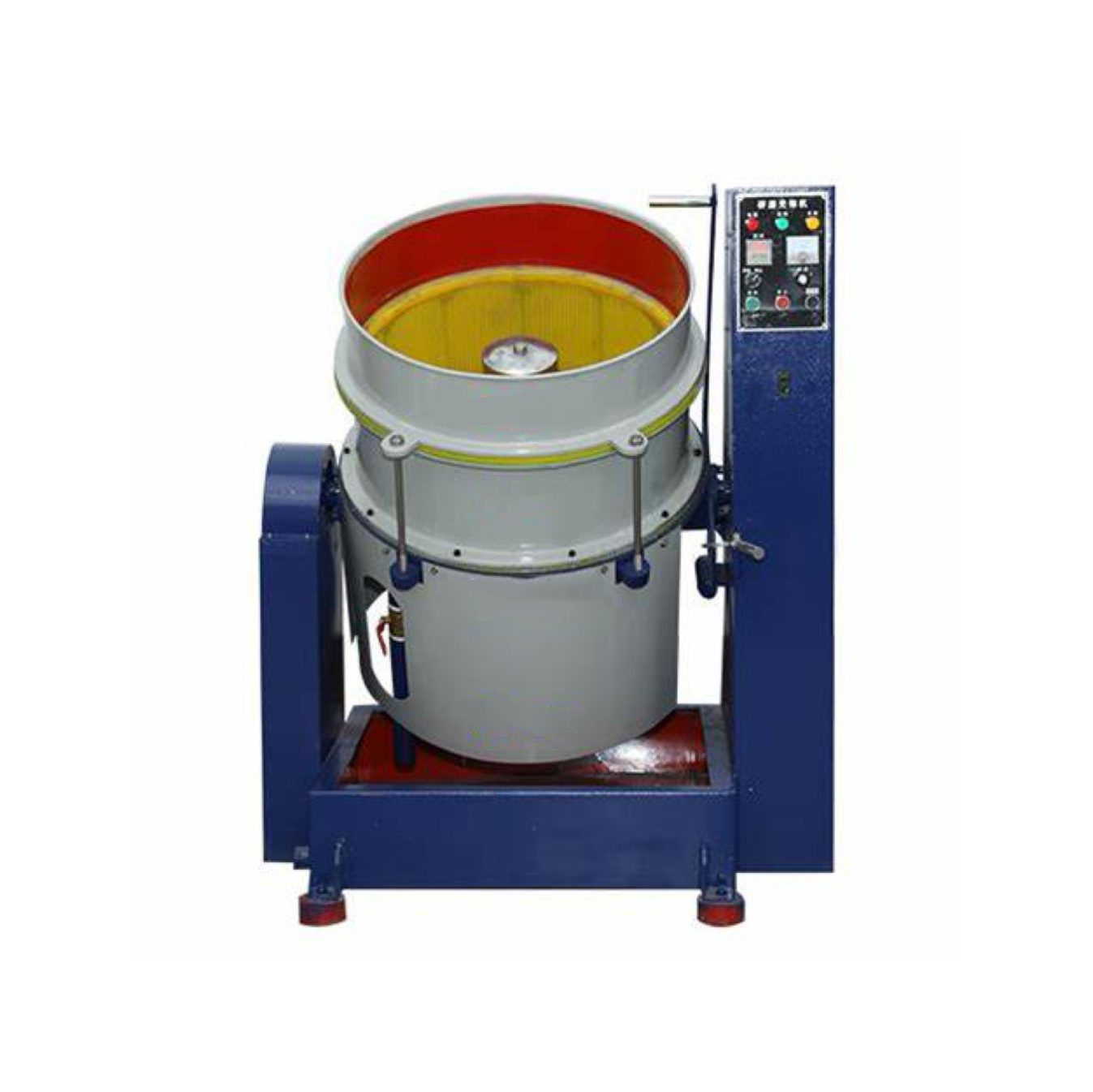
The system utilizes a rotating bottom disc. This disc sits inside a stationary upper barrel. When the disc spins, it pushes the mass outward and upward. The media and parts travel along the stationary urethane-lined wall. Gravity eventually overcomes the outward force. The mass then collapses back to the center. This creates a high-energy, toroidal (doughnut-shaped) rolling action. The continuous turnover ensures uniform exposure to the abrasive media.
The primary benefit here is speed. Achieving intense friction enables rapid material removal. Unlike aggressive tumbling, this method avoids harsh part-on-part impact. The toroidal flow keeps parts suspended within the media matrix. This ensures effective high speed polishing without severe impingement. You achieve fine Ra (roughness average) reductions in a fraction of the traditional time.
This technology excels in specific manufacturing sectors. It handles small-to-medium parts exceptionally well. Complex geometries benefit from the fluid-like media flow.
Coin blanks and minted tokens.
Medical implants requiring surgical-grade finishes.
Precision aerospace components.
Fine jewelry and intricate decorative items.
Despite its efficiency, the centrifugal method has strict boundaries. It is not suitable for exceptionally long parts. Heavy or bulky components disrupt the fluid motion. Parts that exceed the disc's rotational parameters can stall the motor. They might also sustain damage from hitting the stationary walls abruptly.
Common Mistake: Overloading the processing chamber. Excessive volume restricts the toroidal roll. This leads to uneven finishes and extended cycle times.
Vibratory tubs and bowls represent the industry standard. They have served manufacturing facilities reliably for decades. Their design prioritizes controlled, sustained energy over rapid material removal.
These machines rely on eccentric weights mounted on a drive motor. These weights generate omnidirectional vibrations. The vibrations transfer through the springs into the processing tub or bowl. This action causes the media and parts to scrub against each other. The mass moves in a slow, helical pattern. It ensures consistent, repeatable friction across all part surfaces.
The greatest strength of vibratory equipment is its flexibility. These systems handle incredibly diverse payloads. Large tub formats easily accommodate massive engine blocks. They can process long metal extrusions without jamming. Delicate, heavy castings rest safely within the vibrating media. You can adapt a single vibratory bowl to run dozens of different part profiles.
Vibratory machines deliver slower material removal rates. This provides a highly controlled, gentle environment. It significantly minimizes the risk of part distortion. Fragile edges remain intact during the deburring phase. Threads and intricate details suffer less wear compared to high-energy alternatives.
The primary drawback is processing speed. Extended processing times often pose challenges. Cycles are usually measured in hours rather than minutes. An eight-hour deburring cycle can easily create severe workflow bottlenecks. Facilities must offset these slow cycles by purchasing larger, higher-capacity bowls.
Best Practice: Utilize flow-through compound systems. Pumping fresh compound through the bowl keeps media clean. It prevents glazing during prolonged, multi-hour cycles.
Selecting the right method requires a direct comparison. We must evaluate centrifugal finishing against vibratory systems across key production metrics.
Speed dictates factory flow. Centrifugal systems finish parts in minutes per cycle. A typical batch takes between 15 and 30 minutes. The high G-force output aggressively strips burrs and refines surfaces. Vibratory systems take hours per cycle. A standard batch requires 2 to 8 hours. They rely on lower energy and sustained friction.
Verdict: Centrifugal finishing wins on raw speed and rapid batch turnover.
Dimensional limitations define equipment suitability. Centrifugal machines are strictly limited by chamber diameter. Parts must flow freely within the toroidal roll to avoid jamming. Vibratory systems are highly accommodating. Large rectangular tubs can handle long or awkwardly shaped components easily. You can even isolate delicate parts into separate compartments.
Verdict: Vibratory wins on dimensional flexibility.
Budgetary considerations go beyond the initial purchase price.
Upfront Costs: Centrifugal machines require a higher initial investment. They utilize robust motors. They also feature precision-machined rotating gaps.
Consumables: High-energy centrifugal action breaks down abrasive media faster. This increases ongoing consumable costs significantly.
Labor & Power: Centrifugal systems process substantially more parts per hour. This drastically reduces labor-per-part costs. It also lowers overall power consumption per batch.
Evaluation Metric | Centrifugal Disc Systems | Vibratory Systems |
|---|---|---|
Cycle Time | 15 - 30 Minutes | 2 - 8 Hours |
Energy Output | High (Up to 15x gravity) | Low to Moderate |
Part Size Limit | Small to Medium (Under 6 inches typical) | Large, Long, or Heavy (No strict limit) |
Media Degradation | Fast (Higher replacement frequency) | Slow (Extended media lifespan) |
Initial CapEx | Higher | Lower |
Paper specifications rarely capture the full operational reality. Integrating a centrifugal disc polishing machine requires specific maintenance awareness. You must understand these daily demands before finalizing procurement.
The gap is a critical maintenance reality. It exists between the spinning disc and the stationary wall. Operators must monitor and adjust this gap clearance regularly. If the gap widens, small parts or media will lodge inside it. This causes severe friction, damages the parts, and can stall the drive motor. Routine calibration prevents these costly production halts.
High-energy forces accelerate equipment wear. Polyurethane linings degrade faster in centrifugal environments. The intense pressure and abrasive media scrub the walls constantly. Facilities must plan for scheduled relining. Ignoring degraded urethane exposes the underlying steel. This destroys both the machine and the processed components.
Speed introduces new logistical challenges. High-speed processing requires equally fast part-media separation. If a batch finishes every 20 minutes, manual sorting becomes impossible. You must integrate automated solutions. Magnetic separators work well for ferrous parts. Vibratory screen separators handle non-ferrous components. Proper separation automation prevents post-processing bottlenecks.
Factory real estate is always expensive. Centrifugal setups often boast a smaller footprint per part processed. However, they require significant vertical clearance. Loading hoppers and unloading mechanisms sit above and below the main chamber. Facility planners must ensure adequate ceiling height before installation.
Choosing between these technologies demands a structured approach. Use this four-step framework to finalize your equipment selection accurately.
Begin with physical measurements. If parts are larger than 6 to 8 inches, default to vibratory equipment. If parts are highly fragile or excessively heavy, vibratory remains the safer choice. If parts are small, dense, and produced in high volumes, lean toward centrifugal systems.
Look beyond the machine's price tag. Map the cost of running a 4-hour cycle in a vibratory bowl. Compare it against a 20-minute cycle in a centrifugal disc machine. Factor in the operator's labor hours. Include the accelerated media wear of the centrifugal method. This calculation reveals the actual production cost per batch.
Analyze your broader factory workflow. Assess whether the facility requires continuous inline finishing. Continuous flow strongly suits vibratory bowl layouts. Conversely, assess if your production relies on rapid batch processing. Cell-based manufacturing often prefers the swift turnover of centrifugal setups.
Never purchase surface finishing equipment based on spec sheets alone. Require the manufacturer to run your specific parts. Verify the Ra improvements under laboratory conditions. Test the media separation efficacy. This practical trial confirms whether the machine matches your specific alloy and geometry.
The strategic trade-off in surface finishing centers on speed versus flexibility. Investing in high-energy equipment transforms production timelines for specific part profiles. Vibratory methods provide an undeniable safety net for varied, large-scale, or awkward components. Your final choice dictates your factory's future efficiency.
Audit your part dimensions and daily volumes before looking at machine specifications.
Account for the increased consumable costs and specific maintenance needs of high-speed setups.
Design your workflow to handle rapid media separation if choosing faster cycle times.
Conduct a quantifiable trial run using actual facility data before finalizing the procurement.
A: Yes, but it requires caution. You must balance the high energy with specialized, lightweight media. Using high-density plastics or fine ceramics reduces impact forces. It is generally riskier than vibratory finishing. However, achieving success is possible by enforcing strict parameter controls and shorter cycle times.
A: Replacement frequency depends heavily on your process. Highly abrasive media, like ceramic triangles, wear linings faster. Running continuous, multi-shift duty cycles also accelerates degradation. Typically, linings last between one and three years. Regular visual inspections are mandatory to determine the exact replacement schedule.
A: Absolutely. Both technologies support automation. Centrifugal systems generally utilize batch automation. Hydraulic loaders dump parts in, and pivot mechanisms unload them onto screens. Vibratory bowls can support continuous flow options. Parts feed in steadily and climb an internal ramp for automated, continuous discharge.
A: Higher media consumption comes down to physics. The toroidal action generates massive kinetic energy. This intense friction strips material from the metal parts rapidly. Consequently, it also breaks down the abrasive media faster. The sheer force fractures and smooths the media matrix at an accelerated rate.