- Home
- Machine
- Media
- Application
- Service
- About Us
- Blogs
- Contact Us
- All
- Product Name
- Product Keyword
- Product Model
- Product Summary
- Product Description
- Multi Field Search


Views: 0 Author: Site Editor Publish Time: 2026-07-31 Origin: Site
Purchasing finishing media by the pallet carries heavy financial and operational stakes. Ordering the wrong material at this scale leads to ruined batches, excessive cycle times, and massive waste disposal headaches. Scaling up mass finishing operations requires a deliberate transition from small-batch experimentation to standardized, high-volume production. You must navigate complex technical specifications—such as shape, size, bond hardness, and abrasive grit—while ensuring supply chain reliability for your finishing requirements. We built this guide as a comprehensive, engineering-focused framework for evaluating, testing, and procuring Ceramic Media in bulk without compromising production quality or budget. By understanding the mechanical interactions between media geometry, machine dynamics, and part metallurgy, facility managers can establish highly repeatable finishing processes that protect part tolerances and optimize throughput.
Workpiece metallurgy directly dictates media selection. Hard metals like stainless steel, titanium, and carbon steel require a dense, aggressive matrix to achieve meaningful material removal. Ceramic is the industry workhorse for these applications because its heavy mass drives the abrasive grains into the workpiece with sufficient force to shear off burrs and smooth rough edges. Lighter alternatives simply bounce off hard alloys without altering the surface topography. Matching media density to material hardness establishes the foundation for an efficient process. High-density media transfers more kinetic energy from the vibratory bowl to the part. If the initial surface roughness (Ra) is exceptionally high, an aggressive formulation is necessary to knock down peaks quickly. Conversely, parts requiring only minor refinement benefit from a less aggressive matrix that focuses on surface blending rather than heavy cutting.
Intricate assemblies, small stainless steel rings, and thin-walled components introduce significant tolerance risks. Using overly aggressive media on these delicate parts causes rapid dimensional loss. Operators must implement strict process controls to prevent critical features from washing out. Balancing the need for burr removal against the preservation of tight tolerances requires careful evaluation of the media's cutting classification.
| Material Type | Hardness Level | Recommended Media Density | Primary Application |
|---|---|---|---|
| Carbon Steel | High | High Density / Fast Cut | Heavy burr removal, edge radiusing |
| Stainless Steel | High | Medium to High Density | Deflashing, surface smoothing |
| Titanium | Very High | High Density / Ultra-Fast Cut | Aggressive machining mark removal |
| Aluminum Alloys | Low to Medium | Low Density / Non-Abrasive | Burnishing, light polishing |
Mass finishing encompasses several distinct operations, including heavy cutting, radiusing, deflashing, and surface smoothing. Heavy cutting removes substantial material to shape the part or eliminate deep machining marks. Radiusing rounds off sharp edges to specific dimensional requirements. Deflashing breaks away excess material left from casting or molding processes. Surface smoothing reduces the Ra value to prepare the component for plating, anodizing, or final assembly.
Facility managers must weigh the trade-offs between aggressive cutting and fine finishing. Aggressive media yields faster cycle times but suffers from higher wear rates, requiring more frequent replenishment. Transitioning to ceramic polishing media extends cycle times and produces a smoother finish with minimal media degradation. High-volume production environments demand established baseline metrics for acceptable cycle times to prevent finishing bottlenecks from disrupting downstream assembly operations.
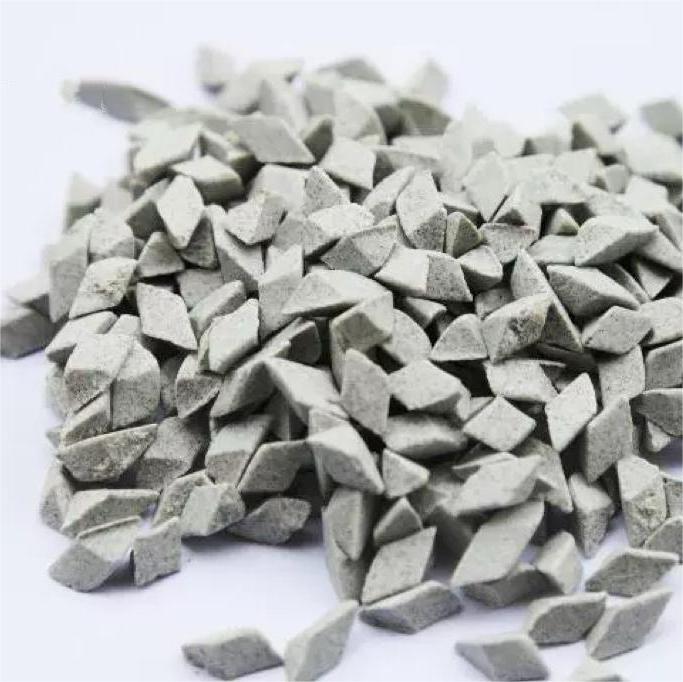
Industrial finishing relies on specific geometric shapes to target different part features. Angle-cut cylinders provide excellent flat-surface coverage while their angled faces penetrate corners. Triangles offer sharp points for reaching into tight recesses and slots. Stars deliver multiple contact points for complex geometries, and cones are ideal for concave surfaces and blind holes where flat-sided shapes might stick. Round shapes like spheres prevent chipping on delicate edges because they lack sharp corners that could impact the workpiece too aggressively.
A structured decision matrix helps operators select shapes based on part features. The primary objective is maximizing surface contact while eliminating the risk of impingement. Selecting shapes that cannot physically lodge in slots, threads, or blind holes is paramount. Lodged media halts production, forcing workers to manually clear obstructed holes, which destroys the efficiency gained by automated mass finishing.
| Media Shape | Best For | Avoid When |
|---|---|---|
| Angle-Cut Cylinder | Flat surfaces, reaching into 90-degree corners | Parts with holes matching the cylinder diameter |
| Triangle | Slotted parts, sharp internal corners | Fragile edges prone to chipping |
| Cone | Blind holes, concave surfaces | Parts requiring heavy flat-surface abrasion |
| Sphere | Burnishing, delicate parts, preventing edge damage | Parts with tight internal angles or slots |
The rule of sizing dictates that media must be significantly larger or smaller than the part's smallest cavities. If a part features a half-inch bore, using half-inch media guarantees impaction. Sizing the media correctly ensures it flows freely through the part's geometry without wedging into gaps. Certain applications require extremely small ceramic tumbling media, often referred to as micro-media. This niche solution is the only viable option for reaching into complex, internal geometries where larger shapes or plastic alternatives cannot fit. Micro-media flows like coarse sand, providing uniform abrasion across intricate internal channels and micro-machined features.
Post-tumbling separation logistics heavily influence size selection. The chosen size must be compatible with existing vibratory screen decks or magnetic separation equipment. If the media and the parts are too similar in size, mechanical screening becomes impossible. Operators must account for media wear over time. A shape that starts at a safe size will eventually shrink. If it shrinks into the exact dimension of a part's slot or hole, it becomes a severe lodging hazard after multiple cycles.
Ceramic finishing products consist of abrasive grains suspended in a fired ceramic binder. The type of abrasive grain dictates the cutting characteristics. Aluminum oxide is the standard choice for general-purpose deburring, offering a good balance of toughness and cutting speed. Silicon carbide is sharper and harder, making it suitable for specialized applications requiring aggressive material removal on very hard alloys.
Suppliers categorize cutting speeds using standardized industrial classifications to help buyers match the formulation to their throughput targets. These classifications typically range from Light Cutting for gentle surface refinement, to Medium Cutting for standard deburring, up to Fast/Extra-Fast and Ultra-Fast Cutting for rapid edge radiusing and heavy stock removal. Selecting the right classification ensures the process meets production timelines. Bond hardness controls how quickly the abrasive grains are released. Softer bonds break down faster, constantly exposing fresh, sharp abrasive to the workpiece. This results in a high cut rate but rapid media wear. Harder bonds retain the abrasive grains longer, providing a slower cut but significantly extending the life of the media. Balancing bond hardness against required cycle times is a critical engineering decision.
Dimensional and density consistency across pallets is critical for automated, repeatable manufacturing. When a facility dials in a specific cycle time, compound flow rate, and water ratio, they rely on the media performing exactly the same way every time a new batch is loaded into the machine. Inconsistent media disrupts this delicate balance. Variations in size or abrasiveness force operators to constantly adjust cycle times, effectively destroying process standardization. If one pallet cuts 20% faster than the previous one, parts will be over-tumbled and potentially scrapped. Strict quality control from the manufacturer ensures that every piece of media performs predictably, safeguarding part quality across thousands of production hours.
Calculating the true operational impact requires a comprehensive framework: Purchase Price + Freight + Wear Rate + Disposal Costs. Focusing solely on the initial invoice often leads to poor procurement decisions. Cheap media frequently utilizes low-quality binders that fracture and disintegrate rapidly under the intense kinetic forces of a vibratory bowl. Evaluating a supplier's stated attrition rate is essential. Media that breaks down twice as fast requires twice as much replenishment, doubling the actual consumption cost. Rapid breakdown increases machine downtime for cleanouts and drastically accelerates the volume of waste material that must be processed and hauled away. Investing in durable, highly consistent media reduces long-term operational expenses.
The environmental and operational realities of media breakdown manifest as sludge generation. As the ceramic binder and abrasive grains wear away, they mix with metal fines and liquid compounds to form a dense slurry. Managing this sludge is a significant operational challenge for high-volume facilities. High-sludge media severely impacts filtration systems, rapidly clogging centrifuge liners and filter paper. It also neutralizes the effectiveness of liquid compounds, requiring higher chemical dosing to keep parts clean. Wastewater treatment compliance becomes increasingly difficult when excessive suspended solids overwhelm the facility's effluent processing capabilities. Selecting media with optimized wear characteristics directly reduces sludge volume and simplifies waste management.
Vetting a supplier's inventory capacity and manufacturing lead times prevents catastrophic production halts. Mass finishing is often the final step before assembly or shipping; a stockout here paralyzes the entire manufacturing floor. Buyers must evaluate whether a supplier manufactures their own product or merely imports and re-labels, as this impacts their ability to respond to sudden spikes in demand. Establishing blanket orders or safety stock agreements mitigates the risks of supply chain disruptions. By committing to a forecasted volume, facilities can lock in reliable delivery schedules and ensure the supplier holds dedicated inventory ready to ship on demand. This strategic partnership stabilizes production planning and eliminates the panic of expedited freight.
Never commit to a bulk purchase without running a pilot test on actual production parts. Requesting and testing samples is a mandatory step in the procurement process. A proper protocol involves running the proposed media in the facility's own equipment, using standard compounds and water flow rates, to replicate true production conditions. During the pilot run, engineers must measure specific parameters to validate performance. Surface finish (Ra) must be checked against part blueprints. Cycle time must be recorded to ensure it meets throughput requirements. Media weight loss should be measured before and after the cycle to calculate the attrition rate. Finally, part dimensional integrity must be verified to ensure critical tolerances remain unaffected by the tumbling process.
Receiving bulk heavy materials involves specific logistical considerations. LTL freight is standard, but buyers must be aware of pallet weight limits and liftgate requirements if the facility lacks a dedicated loading dock. Coordinating delivery schedules prevents bottlenecks in the receiving area. Packaging options must align with the facility's material handling equipment. Supersacks are efficient for large, automated hoppers but require heavy-duty forklifts or overhead hoists to maneuver safely. Standard 50lb boxes stacked on pallets offer more flexibility for manual loading into smaller vibratory bowls. Proper storage is necessary to prevent moisture contamination or physical degradation of the media prior to use. Keep pallets in a dry, climate-controlled area to maintain the integrity of the ceramic binder.
Excessive material removal or edge rolling is a common risk when using aggressive ceramic deburring media. Hard, sharp abrasives cut quickly, and leaving parts in the machine too long alters their fundamental geometry. This is particularly dangerous for precision-machined components with strict dimensional tolerances. The time-tracking trap is a frequent source of operator error. Losing track of time for even a few minutes with fast-cutting or ultra-fast formulations can ruin an entire batch of high-tolerance parts. Relying on manual timekeeping in a busy manufacturing environment guarantees eventual failure. Mitigation requires establishing strict automated timer controls integrated directly into the machine's power supply. Standard operating procedures must clearly define cycle times for every specific part number. Regular quality-control check intervals during the cycle allow operators to monitor progress and pull parts exactly when the desired finish is achieved.
Lodged media causes severe production bottlenecks, requiring tedious manual rework with picks and punches to clear obstructed holes. This completely negates the labor-saving benefits of automated mass finishing and introduces the risk of scratching or damaging the part during the removal process. Mitigating this risk demands strict sizing guidelines during the initial selection phase. Facilities must implement regular media screening protocols. As media wears, undersized pieces must be continuously filtered out of the working mass before they shrink enough to become lodging hazards. Utilizing specialized shapes like angle-cut cylinders or stars also reduces the likelihood of impaction in round bores.
Different bulk media densities interact uniquely with specific finishing equipment. Vibratory bowls, centrifugal barrel tumblers, and rotary barrels each exert different forces on the media mass. Heavy ceramic formulations generate significant kinetic energy and friction. Before introducing high-density media into older equipment, maintenance teams must verify motor load capacities. The increased weight can strain drive motors and eccentric weight assemblies, leading to premature mechanical failure. The polyurethane lining thickness must be inspected. Aggressive ceramic wears down bowl linings faster than plastic or synthetic alternatives, requiring more frequent relining schedules to prevent catastrophic wear-through to the steel tub.
A: Lifespan depends entirely on bond hardness, equipment type, and cycle times. Aggressive, soft-bond formulations wear quickly to expose fresh abrasive, while hard-bond media lasts significantly longer. Facilities must measure specific attrition rates by weight loss per cycle rather than estimating lifespan by time.
A: Ceramic is much denser and designed for hard metals and heavy cutting applications. It effectively shears burrs off steel and titanium. Plastic is lighter, produces a smoother, less reflective finish, and is primarily used for softer metals like aluminum or zinc to prevent surface damage.
A: The fundamental rule is to choose a shape that can physically reach all necessary surface areas but is geometrically incapable of lodging in the part's holes, slots, or recesses. Angle-cut cylinders are excellent for general use, while triangles reach into tight corners.
A: While possible with high-density, non-abrasive formulations, it is generally not recommended. The heavy mass of ceramic can cause surface peening or roll the edges of soft metals. Plastic or synthetic media is the preferred choice for finishing aluminum and brass components safely.
A: Determine the working capacity of the tumbler bowl, then factor in the optimal media-to-part ratio—usually 3:1 or 4:1 by volume. Convert this total required volume to pounds based on the specific bulk density of the chosen media formulation.
A: Glazing occurs when metal fines, oils, and degraded binder coat the media surface, rendering the abrasive grains ineffective. Prevent this condition by maintaining the correct liquid compound flow rate and water ratio to continuously flush away debris and keep the media clean.