- Home
- Machine
- Media
- Application
- Service
- About Us
- Blogs
- Contact Us
- All
- Product Name
- Product Keyword
- Product Model
- Product Summary
- Product Description
- Multi Field Search


Views: 0 Author: Site Editor Publish Time: 2026-01-29 Origin: Site
Centrifugal disc polishing machines are crucial for mass finishing in various industries. They help achieve smooth, polished surfaces in a fraction of the time compared to traditional methods. In this article, we will delve into how these high-energy machines operate, their key functions, and the benefits they provide across industries like automotive, aerospace, and jewelry. You’ll discover the science behind their efficiency and why they are essential in modern manufacturing.
The centrifugal disc polishing machine operates on the principle of centrifugal force. At the base of the machine, a high-speed spinning disc creates intense centrifugal force, pushing both parts and abrasive media upwards along the barrel’s walls. As the parts and media reach the top of the barrel, they fall back down, repeating the cycle. This motion generates powerful friction between the parts and the abrasive media, allowing the machine to efficiently polish, deburr, and smooth the parts.
When the parts and abrasive media are propelled against the barrel’s stationary walls, they engage in continuous rubbing and contact. This friction creates a high-energy environment that rapidly removes burrs, sharp edges, and surface imperfections. As the cycle repeats, the parts are exposed to consistent friction, ensuring that the surface finish is refined and polished. The high-speed action reduces the amount of time required to achieve a smooth, even finish.
The process inside the machine creates a doughnut-shaped (toroidal) flow of parts and abrasive media. This circular motion enhances the polishing process by allowing every part to come into contact with the abrasive media and barrel walls in a consistent manner. The result is a thorough and uniform surface finish that is hard to achieve with traditional methods. This motion ensures that parts are polished from all angles, including intricate grooves and corners, which are often difficult to reach.
Deburring is a critical function of the centrifugal disc polishing machine, particularly for parts that have been machined, stamped, or cast. The machine removes sharp edges and burrs, which can cause safety hazards or mechanical failure. This is achieved through the abrasive action of the media, which smooths out the sharp edges left on parts during manufacturing. The result is a safer, more reliable part ready for further processing or use.
| Key Parameters | Description | Suitable Materials | Main Advantages | Technical Specifications |
|---|---|---|---|---|
| Abrasive Media Type | Ceramic, plastic, organic, steel | Metals, plastics, ceramics | Removes sharp edges, improves safety | Grit: 10-600 mesh |
| Deburring Action | High-energy friction, repetitive motion | Machined, stamped, and cast parts | Reduces burrs, enhances functionality | Speed: 50-180 RPM |
| Process Time | Short cycle times | Automotive, aerospace, medical parts | Minimizes time, enhances throughput | Cycle Time: 5-15 minutes |
| Final Finish Quality | Smooth, uniform surface | Any material requiring deburring | Improved part safety and reliability | Surface Finish: Low RMS to high gloss |
Tip: Selecting the right abrasive media and machine settings ensures that burrs are effectively removed while maintaining part integrity.
One of the primary uses of a centrifugal disc polishing machine is polishing. The machine can achieve a variety of surface finishes, ranging from satin to high-gloss mirror finishes, depending on the materials and polishing compounds used. By rotating the parts and media at high speeds, the machine delivers consistent and high-quality results across large batches. This is particularly valuable in industries where aesthetics are as important as functionality, such as in jewelry and high-end automotive parts.
Another key function of the centrifugal disc polishing machine is radiusing, or edge rounding. This process softens sharp corners or edges on parts, making them safer to handle and improving their functionality. The machine’s ability to apply uniform pressure to parts allows for consistent edge rounding, which is especially important in precision manufacturing. Radiused edges are crucial in industries like medical device manufacturing, where sharp edges can be a safety concern.
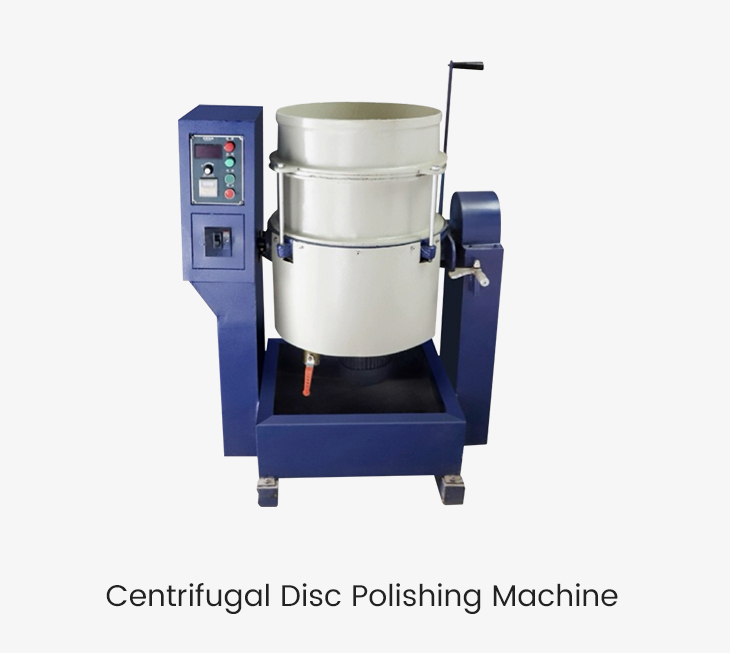
In the jewelry industry, centrifugal disc polishing machines are essential for polishing metals like gold, silver, and platinum, as well as other precious alloys. The high-speed action of the machine allows for the efficient polishing of intricate jewelry designs, achieving a uniform and high-quality finish. The ability to handle multiple parts simultaneously makes these machines particularly valuable for high-volume production. Polishing rings, necklaces, and bracelets to a mirror-like shine is made easier and faster with centrifugal disc polishing machines.
In the automotive and aerospace industries, centrifugal disc polishing machines are used to deburr and smooth engine components, turbine blades, gears, and fasteners. These parts require precise finishing to ensure smooth operation and prevent wear. The machine's ability to handle small, complex parts with intricate shapes makes it ideal for these industries. The polishing and deburring process not only improves the parts' aesthetics but also enhances their functionality by ensuring smoother surfaces and better mechanical performance.
The medical and electronics industries also benefit from the use of centrifugal disc polishing machines. In the medical field, the machines are used to finish surgical instruments, dental implants, and other precision tools, ensuring that they have smooth, sterile surfaces. In electronics, the machines help finish delicate components, such as connectors, circuit boards, and sensors, ensuring they are free from surface contaminants and defects. The machine’s precision and ability to work on small, intricate parts make it an invaluable tool in these sectors.
One of the most significant advantages of using a centrifugal disc polishing machine is the speed at which it operates. The high-energy action of the machine allows for processing times to be up to 90% faster than traditional methods. This is especially valuable in mass production environments, where time efficiency directly translates to cost savings and increased throughput. The rapid cycle time enables manufacturers to polish and deburr large batches of parts in a fraction of the time, increasing overall productivity.
Centrifugal disc polishing machines excel in delivering superior surface finishes. The machine’s controlled friction ensures that every part receives the same level of polish and refinement, even for intricate or complex geometries. The consistency and quality of the finish are unmatched, making these machines ideal for industries that demand high standards of surface quality, such as jewelry, aerospace, and medical device manufacturing.
Another advantage of centrifugal disc polishing machines is their versatility. These machines can handle a wide range of materials, including metals, plastics, and ceramics, making them suitable for various applications across multiple industries. The machine’s precision allows it to work with parts of different sizes and shapes, including small, delicate components with intricate features. Whether polishing jewelry or smoothing automotive parts, the centrifugal disc polishing machine delivers consistent, high-quality results.
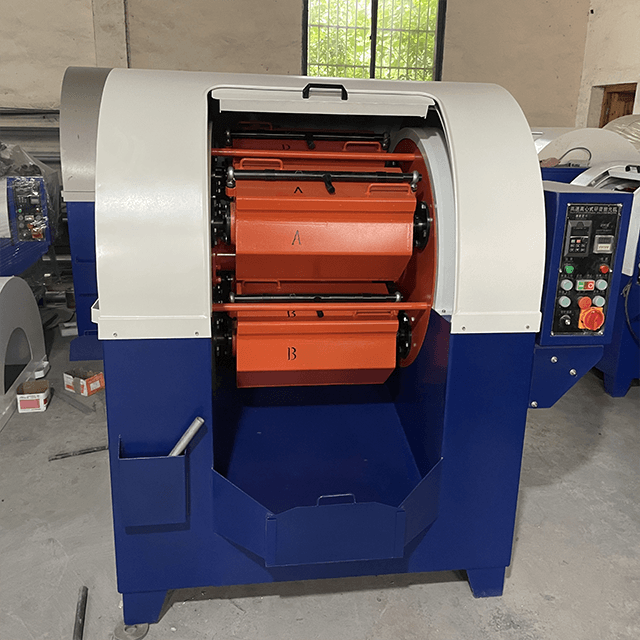
Common media types used in centrifugal disc polishing machines include ceramic, plastic, and organic media. Ceramic media is often used for aggressive deburring and polishing, while plastic media is gentler and more suitable for delicate parts. The choice of media depends on the material of the parts being finished and the desired finish quality. It is essential to match the media type with the material to ensure optimal results.The following table lists common types of abrasive media, their suitable materials, and their key characteristics to help you make an informed choice based on your processing needs.
| Media Type | Suitable Materials | Key Features | Applicable Processes | Technical Specifications |
|---|---|---|---|---|
| Ceramic Media | Metals (steel, aluminum, copper), plastics, ceramics | High hardness, suitable for aggressive deburring and polishing | High-energy deburring, roughness control | Grit: 10-600 mesh |
| Plastic Media | Soft metals (aluminum), plastics, glass, ceramics | Suitable for fine polishing, reduces wear, smooth surface | Polishing, cleaning, gloss enhancement | Grit: 10-120 mesh |
| Organic Media (e.g., wood, fiber) | Soft metals, wood, plastics | Gentle on surfaces, reduces wear and part damage | Fine polishing, suitable for soft materials | Grit: 12-240 mesh |
| Stainless Steel Media | Metals (steel, copper, aluminum), plastics | High durability, suitable for high-precision processes | Fast deburring, suitable for hard metal surfaces | Grit: 80-600 mesh |
Polishing compounds play a vital role in achieving high-quality finishes. Compounds such as emery-based, diamond-based, and alox-based are commonly used in centrifugal disc polishing machines. Emery-based compounds are ideal for achieving satin finishes, while diamond-based compounds are perfect for high-gloss finishes. The compound selected should align with the material being polished and the desired surface quality. For example, diamond-based compounds are ideal for polishing hard metals and ceramics, providing a superior, mirror-like finish.
The compound selected should be compatible with the material of the parts being finished. For example, emery-based compounds work well with metals like brass and steel, while cerium oxide-based compounds are ideal for polishing glass and ceramics. It is essential to understand the material’s properties and the desired finish before selecting a compound. Additionally, using the right compound helps prevent material damage and ensures that the surface quality is consistent across all parts.
With technological advancements, automation features have become standard in many industrial machines, enhancing productivity. The following table lists common automation options for centrifugal disc polishing machines and their advantages in improving production efficiency and reducing manual intervention.
| Automation Option | Description | Suitable Applications | Main Advantages | Technical Specifications |
|---|---|---|---|---|
| Automatic Feed System | Automatically loads parts and abrasive media into the machine | High-efficiency, high-volume production | Reduces manual intervention, increases efficiency | Feed Speed: 50-200 parts/min |
| Automatic Unloading System | Automatically separates parts from abrasive media after polishing | Automated production lines | Improves continuity of workflow, reduces operator errors | Unloading Speed: 30-150 parts/min |
| Automated Media Dosing System | Automatically adds abrasive media and compounds to the machine | Custom production | Ensures even media distribution, enhances surface consistency | Dosing Frequency: Programmed settings |
| Automatic Separation Sieve System | Automatically separates finished parts from abrasive media | Batch processing | Increases separation efficiency, ensures rapid part-media separation | Separation Precision: 0.05mm |
Tip: Automation features not only boost productivity but also minimize human error, ensuring consistent product quality while reducing labor costs.
Centrifugal disc polishing machines can be customized for specific applications, depending on the type of parts being processed and the desired finish. Manufacturers can adjust the machine’s speed, cycle time, and media selection to tailor the process to their needs. Some machines even offer multiple barrels for different media types, allowing for a more specialized approach. Customization ensures that the machine meets the unique requirements of each industry, whether it’s polishing jewelry, finishing automotive parts, or smoothing medical devices.
Centrifugal disc polishing machines play a crucial role in delivering superior surface finishes in various industries. These high-energy machines efficiently deburr, polish, and smooth parts at high speeds, making them indispensable in mass production. Their versatility, precision, and automation capabilities ensure consistent, high-quality results across different materials. Industries such as jewelry, automotive, aerospace, and medical benefit from faster production, improved surface quality, and reduced processing times. Norden offers centrifugal disc polishing machines that enhance production efficiency and product quality, providing reliable solutions for your finishing needs.
A: A centrifugal disc polishing machine uses centrifugal force to efficiently deburr, polish, and smooth parts. It operates by spinning a high-speed disc that pushes parts and abrasive media upwards, creating friction for surface refinement.
A: The machine generates intense centrifugal force, causing parts and abrasive media to move in a circular motion. This action creates friction between the parts and media, effectively polishing and deburring surfaces for a smooth finish.
A: The key functions include deburring, polishing, and radiusing. It removes sharp edges, improves surface brightness, and softens corners for safer and more reliable parts.
A: Industries such as jewelry, automotive, aerospace, and medical benefit from these machines. They improve surface quality, reduce processing times, and enhance production efficiency.
A: The centrifugal disc polishing machine is faster, more efficient, and provides consistent results across large batches, making it ideal for mass production environments.
A: The cost varies depending on the machine’s size, capabilities, and automation features. Typically, these machines are an investment for large-scale operations seeking high-quality finishes and efficiency.


